European Approved Small Tracked Machines: A Handbook to Conformity
European Approved Small Tracked Machines: A Handbook to Conformity
Blog Article
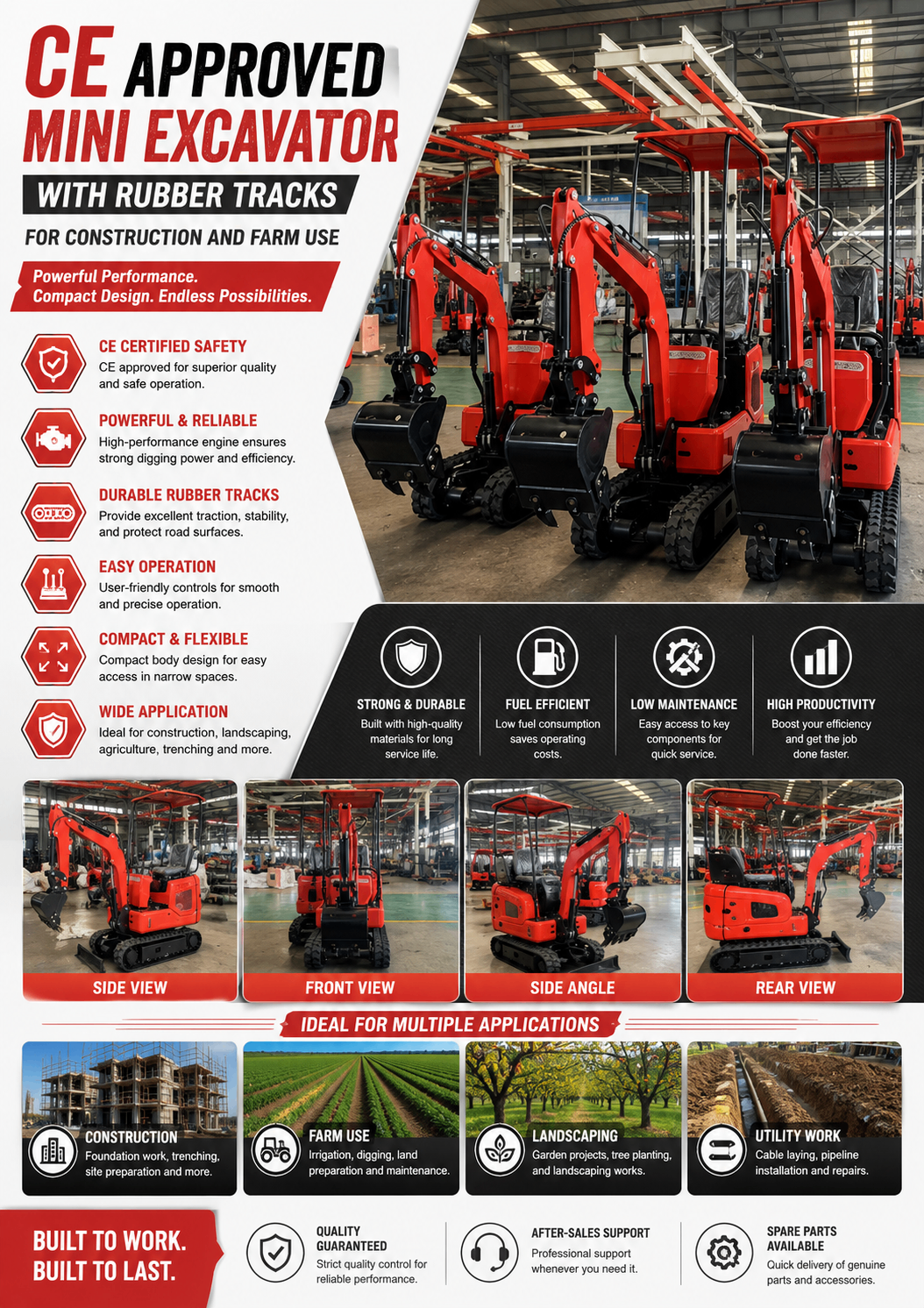
Ensuring your mini digger meets CE certification requirements is vital for operation within European markets. This guide explains the necessary aspects of EU accreditation for compact tracked machines, such as regulations related to operator protection, equipment evaluation, and paperwork. Understanding the specifications allows companies to correctly operate their equipment and avoid serious legal action.
Rubber Track Mini Excavators: Outstanding Traction for Challenging Terrain
Mini excavators equipped with steel tracks are transforming how contractors manage projects in rough situations. Unlike traditional tire-equipped models, these flexible machines offer remarkable traction on loose surfaces like sand, snow, and steep hills. This greater stability allows operators to finish projects effectively and productively, minimizing downtime and increasing productivity. The compliant nature of rubber tracks also reduces ground pressure, preserving delicate surfaces and minimizing environmental damage.
Small Excavators: Big Output in Limited Work Sites
These capable smaller excavators offer a notable answer for tasks where conventional equipment simply maneuver. Their reduced size enables access to difficult areas, including underground systems or within existing structures. Despite their size, they feature substantial trenching force and accuracy, making them perfect for a broad range of demolition applications. Ultimately, small excavators symbolize a smart investment for developers facing the challenges of restricted areas.
Mini Diggers for Farms : Versatility and Effectiveness in Agricultural Jobs
Modern farming operations often require tools that can handle a variety of challenging jobs. Compact diggers are quickly becoming invaluable assets for farmers , offering exceptional adaptability and efficiency across a broad array of agricultural operations . From digging for irrigation setups and runoff to relocating earth for building enclosures or platforms, these machines provide a powerful solution. They even excel at clearing land for planting , smoothing land, and processing materials with simplicity . Their small size allows them to function in limited areas that larger tractors simply cannot access .
- Excavating for Irrigation
- Shifting Soil
- Clearing Land for Planting
Picking the Ideal Mini Machine for Site vs. Agricultural Tasks
When choosing a mini digger , it's vital to recognize the key distinctions between building projects and farm tasks . Building sites often necessitate greater power , precision , and the capacity to function in confined areas . Consequently , a heavy-duty model with a extensive selection of implements might be preferable. Conversely , rural properties frequently involve reduced digging depths , more ground leveling , and the need for small equipment to traverse pastures . In conclusion, careful assessment of the intended tasks is crucial for making the right decision.
- Think about digging requirements.
- Assess the space boundaries.
- Consider the needed attachments .
- Factor in moving challenges .
{CE Labeling & Mini Excavators : What Operators Must to Be Aware Of
Ensuring your {mini compact machine is adheres to relevant European standards is crucial, and that's where {CE certification comes with. This symbol demonstrates that the equipment has been assessed and meets safety requirements, allowing Small construction excavator legal use within the EEA . {For owners of these machines, understanding CE certification is important. It isn't simply about having a label on the digger; it represents a assessment of construction and operation .
- Check the existence of the CE identification.
- Consult the conformity document – this details the standards the digger meets.
- Bear in mind that CE certification is the manufacturer’s responsibility – even users must be informed of its significance.